Text: Marc Navarro
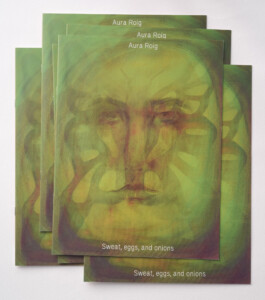
Published at Sweat, eggs, and onions, Goldrausch Künstlerinnenprojekt, Berlin 2025
In the early 1990s, Angela Carter published a comprehensive anthology focused on traditional fairy tales. The stories Carter selected come from various sources, including famous anthologies such as that of the Brothers Grimm, but also the work of folklorists who compiled stories in regions as diverse as Jamaica, Kashmir, Palestine, and Suriname. What connects all of these fairy tales is that none of the protagonists are male. Of course, there is nothing shocking about this fact. What is somehow exceptional is that, while compiling them, Carter points to the fact that the role of telling these stories and, therefore, of passing them on traditionally fell to women and not to men.
The stories Carter collected are not necessarily intended for children. As we read, we witness violent transformations and sudden mutations. In the section entitled “Unhappy Families,” we find dysfunctional families; while reading through the section “Married Women,” we come to understand that quite often happy marriages are just that: nothing more than a simple fairy tale. In the introduction, the author notes: “The stories in this book, with scarcely an exception, have their roots in the pre-industrialized past and unreconstructed theories of human nature. In this world, milk comes from cows, water from wells, and only the intervention of the supernatural can change the relationship between women and men and, above all, between women and their own fertility.”
By bringing these stories together, Carter wanted to contribute to the recognition of the eccentric, poetic, wise, and perceptive nature of those who, anonymously and through the routine exercise of retelling the same story over and over again, found an opportunity to subvert and distort gender norms and the very logic of reproduction.
Aura Roig’s exuberant paintings and the stories Carter brings together in her book sustain, in my view, analogous forms of narrativity. Both reject the normativity of genre: on the one hand, Roig expands the binary opposition men vs. women that Carter mentioned by blurring the boundaries between the human, the vegetal, and the animal; on the other, the act of storytelling and painting both reveal a similar transformative impulse. If Carter’s protagonists do not meet expectations about what they represent and how they exist in the world, Roig’s paintings subvert logical structures in terms of painting genres and its models. In this regard, it is worth noting that portraiture and still life were once considered minor genres and, consequently, reserved for female artists. A notable example is the seventeenth-century Dutch painter Clara Peeters, who produced celebrated depictions of lavishly set tables, symbolic images mirroring Baroque abundance and opulence. In Roig’s paintings, however, the food and objects appear unbeautified. Instead of flowers blooming, we find juicy fruits and vegetables cut in half, exposing their inner layers, flesh ready to be devoured, as if they were mementos mori or sinister ikebana.
What makes this genre subversion successful is the fact that both fairy tales and Roig’s paintings are supported by structures of representation and transmission that look back on a long tradition and are therefore considered reliable: they are familiar territories that one can visit over and over again. Just as tales adopt a pre-established narrative structure based on a premise, a climax, and a denouement, the painting accepts its spatial framework, the canvas, as the necessary limit for the story it contains. They are, so to speak, forms of containment for an overflowing imaginative force: frames for an abyss.
The fantastical, cruel, and unconventional worlds that Carter brings together in her anthology could serve as a background story for Aura Roig’s paintings, which similarly present extraordinary events, improbable scenarios, and unusual characters. Regarding the analogies between humans and plants, what these transformations propose is a change of perspective in relation to the represented subject. With their facial expressions and distinctive features, they appeal to our empathy. The radish or the egg cease to be the product of an economic system—that of food production—integrated into a frenetic choreography of markets and consumption; they become unique. Thus, seemingly mundane motifs become expressive sentient entities.
When I visited Aura Roig in May, the artist was temporarily working and living in a complex consisting of several brick buildings, including a majestic water tower, in the municipality of Dahlewitz, in Brandenburg. The view overlooking the vast cereal crops was occasionally interrupted by the sight of planes arriving and taking off from the nearby airport, reminding us of the city only a few miles away.
In the studio, a piercing, agonized cry interrupted our conversation. A sparrow had nested in one of the building’s beams, and the chicks’ beaks peeked out tremulously, begging to be fed. I can’t think of better company for an artist whose work draws on personal experience to explore family bonds, dependent relationships, attachment, and caregiving. Still, there was a sense of transience about the place, quite the opposite of what you’d call home. What those cold walls did offer Roig was an opportunity to work without distraction: “Depending on my mood, I can finish a painting in just a few days.”
On the way back to the train station, Roig pointed into the distance and mentioned that they sometimes went into the woods to walk or run. It is not unusual to see timid animals, like deer, but also fierce and dangerous creatures, such as wild boars. Forests are common settings for fairy tales: they are far from the sun, the darkness creates its own rules, and one encounters various forms of life.
Carter wrote in her introduction that she “wanted to demonstrate the extraordinary richness and diversity of responses to the same common predicament—being alive.” Roig’s paintings reflect both the diversity and the joy of life manifesting in different forms: a loved one’s face appearing on a spaghetti plate or a long-haired egg. These wonders challenge reasoning, and they use humor to do so. Rather than shaping morals or inspiring terror as fairy tales often do, these characters simply appear before us, eliciting compassion. They seem to say, “Look at me, I do exist!” And indeed, they do.
Marc Navarro
Roig’s work unfolds as a post-surrealist ecosystem in which reality is fragmented to make way for the extraordinary. In this exhibition, their paintings challenge binary logic by fusing identities into a constant flow of hybrid, fluid forms. Roig summons the phantasmagorical, populating a space inhabited by beings that seem to exist between two worlds.
A large-format dreamscapes depict mountains bathed in a fiery, red-orange light that evokes both a lingering sunset and a sky ablaze. In the foreground, hands emerge to confront the viewer, blurring the line between the gaze of the painter and that of the audience. These expansive canvases introduce a symbolic vocabulary—including eggs, eels, and vegetal elements—that reverberates throughout the smaller paintings in the exhibition. The installation unfolds in sequences, generating an evocative narrative of beings in a constant state of metamorphosis.
Their compositions celebrate the multispecies, intertwining humans, animals, and plants in a radical and necessary symbiosis. Each work is a map of the possible, where bodies are defined not by their limits, but by their capacity for transformation.
Olivier Collet
Seagrass swaying in water, caressing ankles, tickling skin. Drops finding their way downward, downward into unknown depths. Bare metal, glittering and promising, cold and hard, piercing membrane. Pain becoming pleasurable, shuddering, expansive; roughness turning into visual delight. Flowing in streams from above, rounded soft limbs, hard small beads, chains, kneading nips make their way. Surfaces appear as versatile, malleable spaces, depths that open up, bodies emerging before the eye. Pressing and devouring, rising and expanding, questioning and hurting, sensing and sweating, tasting and spitting out, never complete.
The soft sculpture We Suddenly Discover To Be Ourselves by Theresa Weber inhabits the space in an uneven, downward-drifting yet simultaneously uplifting form. Three body-like strands composed of diverse materials: textile shaped into spherical forms, braided or filled; long bead-like sequences of wood and plastic; and modelling mass pressed into fabric. They exist as possibilities of different arrangements, refusing a fixed form - they flow, stream, and intertwine. In this movement, softness tips into tension, into incision and opening, into a cold yet playful resonance. In the leather surfaces connected by piercings in Simone Karl's Prick and Pride and Rohrschachtest, bodies become per-meable, vulnerable, and at the same time charged with pleasure. They adhere to walls, connected and penetrated by (coloured) piercings. In Head full of Windchimes, tongues and lip presses, dila-tors, screws, and nuts condense into a system that begins to move like a wind chime. In the tension between pain and pleasure, an inner space of resonance emerges. A threshold between in- and out-side. In the painting The weed is creeping up their feet by Aura Roig, a figure sits between sky and water, open and unbothered. Their gaze is neither inviting nor rejecting. While the sky glows in shades of yellow and green, they remain in contact with the ground of the water. Seagrass wraps around their ankles; they are positioned between surface and depth. Despite their openness, they withdraw from a possessive gaze and assert their own presence. This shift continues in Roig's further works. In Tired of the male gaze or Sweating or Crying, the body itself becomes a carrier of gaze and inquiry; perception is shifting.
Bone to Skin to Body to Touch remains legible, remains in motion: from the inner to the surface, from material to perception, from distance to touch. Bodies appear as permeable states continu-ously re-forming through contact.
Leonie Kennedy
Exhibition Die Fütterung der Fische, Haus Coburg | Städtische Galerie Delmenhorst, 2026
Curated by Matilda Felix.
With Klaus Eberhardt, Asana Fujikawa, Hans-Hendrik Grimmling, Aura Roig.
//translated with online tools
The painter Klaus Eberhardt was born in Delmenhorst in 1954 and studied painting in Braunschweig. Although he exhibited his work only sporadically, he remained committed to painting as a means of communication until his death in 2024. His estate includes works that achieve an independent and deeply sincere visual quality, gaining autonomy once the artist can no longer be asked about their meaning. In place of the artist's self-expression, an active form of seeing emerges, one that takes the paintings seriously as partners in dialogue.
Klaus Eberhardt's paintings encounter works by artists at Haus Coburg who pursue an autofictional figuration in their art and address threats without explicitly naming them. Asana Fujikawa (born 1981 in Tokyo) develops fairytale-like narratives in printmaking series, whose protagonists she then translates into ceramics. This results in delicate figures that cultivate a dissociative state of presence and absence. Hans-Hendrik Grimmling (born 1947 in Zwenkau) grapples with the struggle for freedom in his paintings. Body parts, birds, and plants are recurring motifs with which he metaphorically confronts restrictive and repressive structures. Aura Roig (born 1994 in Tortosa) combines personal experiences and universal ideas in their paintings to create a magical realism. They contrast the family, in particular, as a place of care and the repressive transmission of tradition, with humor in their works.
From different perspectives, the exhibition examines painted figuration and its potential to represent and make tangible the invisible.
Dr Matilda Felix
Exhbition The Strength of Weak Ties, Futur3: Wochen für Kunst und Diskurs, Kiel, 2025
Curated by Mateusz Dworczyk.
With Franca Behrmann, Alime Ertürk, Laura Nan, Max Prange, Aura Roig, Xiaoyi Zhang.
The theme of this year’s Art and Discourse Weeks has been developed in response to current societal and cultural transformations in our globally interconnected world. At its heart are questions about the consequences political upheaval and social ruptures have on the dynamics between individuals, communities and society at large. The starting point is a curatorial concept grounded in the sociological observation that even weak social ties can open up new resources and perspectives for individuals, thereby contributing to the stability and diversity of communities. The group exhibition The Strength of Weak Ties offers an artistic approach to this inquiry. Six emerging artists from Germany and Switzerland explore the complex facets of human relationships through a range of media, artistic techniques, and narrative strategies. Between ideals and reality, Franca Behrmann, Alime Ertürk, Laura Nan, Max Prange, Aura Roig and Xiaoyi Zhang each bring their personal perspectives into play.
However, the works on display do not simply dwell on personal experience. Instead, they open up a deeper understanding of collective processes and social connections. They generate momentum, revealing how it is precisely the fragile that can give rise to the kind of resistant strength needed to confront societal challenges. From familial archives in the work of Alime Ertürk to the collective scream in Xiaoyi Zhang’s paintings, the featured works explore in different ways how fractures can give rise to new connections. These approaches also run through Franca Behrmann’s engagement with her family history, Laura Nan’s endless sleepover, Max Prange’s voices of solitude, and Aura Roig’s visual concepts of radical tenderness. The exhibition invites viewers not to fear these tensions, but rather to understand them as the seed and resource of community.
Aura Roig’s drawings and paintings are marked by a fusion of autobiographical references and a political, queer-feminist stance. Roig often personifies objects, plants, body parts or organs, using them as means of figuration and narration. This allows them to sideline gendered attributions and instead foreground the emotional depth and vulnerability of individuals through facial expression. Recurring themes include the depiction of female* bodies and nonconforming gender identities within the patriarchal system, as well as the social roles assigned in the context of care work. However, Roig’s images are far from overt political statements. They respond to broader systemic conditions through the eyes of an individual, with humour, grotesquery and radical softness.
Mateusz Dworczyk